
The Responsibility Before the New Government, Led by Actor-Turned-Politician Vijay
As the newly formed government led by actor-turned-politician Vijay begins its tenure, Tamil Nadu faces a test greater than an electoral upset. The real question is whether a politics built on adoration can mature into one grounded in fiscal discipline, social repair, public safety and long-term development.
Tamil Nadu enters this new chapter with enormous strengths, but also with visible fatigue. For decades, the state has been shaped by parties that built enduring welfare legacies yet gradually allowed those achievements to harden into entitlement politics, fiscal strain and a culture of reduced accountability. That accumulated exhaustion created the opening for a new force to disrupt a deeply entrenched establishment.
The rise of a new government led by actor-turned-politician Vijay is therefore not merely a story of celebrity crossing into politics, it is also a reflection of public impatience with an old order that had grown too comfortable with habit, symbolism and transactional politics. When people begin to feel that governments can distribute benefits but not renew trust, disruption stops looking risky and becomes necessary. Yet electoral change by itself is not democratic fulfilment, it is only the beginning of a more serious obligation. A government formed on the strength of public enthusiasm must now show that it can govern with restraint, competence and moral clarity. The whistles of victory are fleeting and cannot overshadow the burden of power and the enormous responsibility that comes with it. That burden is heavier when the margins are narrow. A slim majority is still a valid democratic mandate, but it is also a reminder that nearly half the political community may remain unconvinced, anxious or opposed. In such a moment, triumphalism is dangerous. The new government must treat victory not as a license for excess, but as a call for humility, consultation and steady administration. It must listen more carefully, govern more inclusively and avoid the temptation to confuse electoral arithmetic with moral unanimity. The early indications are indeed promising.
A peaceful transition of power matters so deeply. In every healthy democracy, the transfer of authority must be orderly, dignified and free from vendetta, instability or street-level intimidation. The maturity of a democratic culture is tested not only in the casting of votes, but in the conduct that follows the verdict. The chosen leader leads everyone, more so the ones who did not vote in favor. This is especially important in Tamil Nadu, a state with a strong political memory and an emotionally charged public sphere. Cadres who were trained in loyalty and mobilization must now learn the harder discipline of democratic responsibility. The chaos witnessed soon after the results came out was unsettling at best, but sanity seems to have prevailed with serenity and stability resolved. The journey that actually matters begins now.
The failures of earlier governments must also teach lessons for future. The establishment did not fail because it did nothing, it failed because it increasingly blurred the line between welfare and dependency, governance and patronage, compassion and convenience. For too long, elections risked becoming contests of distribution rather than contests of vision. That approach may produce applause, but it also deepens fiscal pressure and weakens the culture of citizenship. A state cannot indefinitely promise more, borrow more and postpone structural correction without eventually narrowing its future choices.
The contradiction is perhaps sharpest in the social sphere. Governments spoke the language of family welfare while remaining comfortable with revenue models and public conditions that often contributed to social distress. They announced safety, but too many women still experienced fear in transit and indifference in systems meant to protect them. They celebrated youth, but too often failed to build clear bridges from education to dignity, work and civic belonging.
This is where the new government will be tested. It must prove that change means more than a change of face. It must show that governance can move from spectacle to seriousness, from distribution to capability, from patronage to public purpose. That requires political courage, the courage to speak honestly about debt, to reform without cruelty, to protect the vulnerable without manufacturing dependency and to invest in long-term systems rather than short-term applause. If this means, revisiting promises surrounding freebies and focusing on stronger fiscally responsible welfare schemes, people will understand with reason. Freebies are defensible during floods, droughts and pandemics. They are an ethical response to sudden vulnerability. But when they become the central grammar of governance, they risk turning relief into dependency and citizenship into clientele. A good government does not merely distribute, it enables. It teaches people how to fish rather than ensuring they remain in line for the next packet of food.
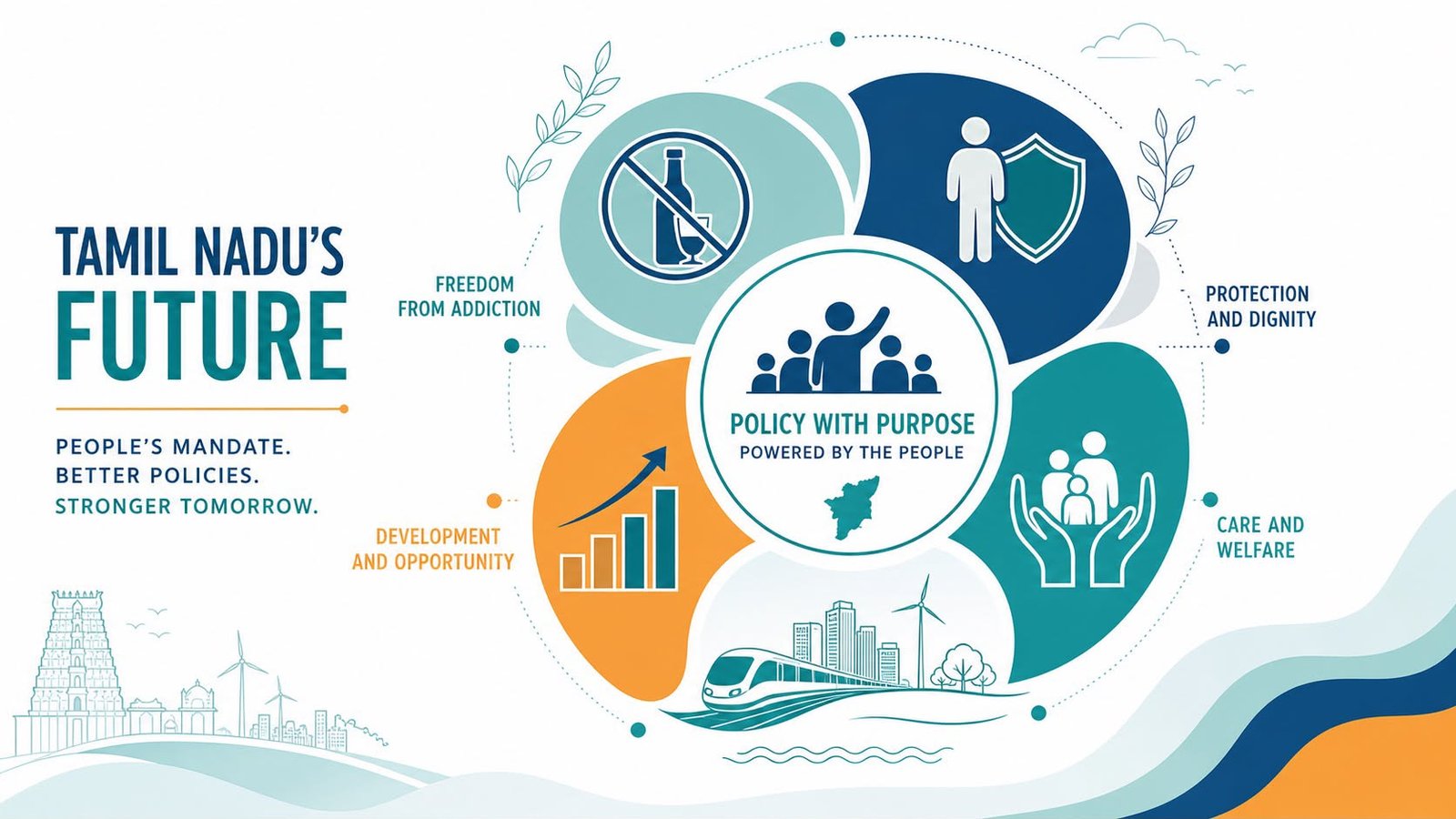
As a psychiatrist working in addiction, I have witnessed the far-reaching consequences of drug and alcohol use on individuals and families. It is imperative for governments to recognize the pervasive impact of Drug and alcohol use on the welfare of families and wellbeing of young adults. It is a force multiplier of poverty, domestic violence, school dropout, depression, accidents and lost labor productivity. A state cannot claim to protect families while growing comfortable with revenue streams that help break them. Nor can it address narcotics and synthetic drug use through police action alone. Tamil Nadu needs a public health led addiction policy, systematic de-addiction programs linked to government health systems, school-based prevention programs, stronger anti-trafficking enforcement and abolition of liquor availability around schools, colleges and labor settlements. This need not mean theatrical overnight prohibition. India’s own history shows that abrupt prohibition without preparation can fuel bootlegging and illicit harm. But a phased path toward partial, and eventually wider, alcohol restriction linked to rehabilitation, alternative livelihoods and behavioral health would be a far more serious legacy than allowing the state to remain dependent on intoxication for revenue.
Tamil Nadu does not also need endless emotional mobilization. There is a rich legacy of social and economic development, thanks to progressive policies of previous governments going back decades. However, populism expanded faster than reform, political theatre often outran institutional repair and the difficult work of preparing Tamil Nadu for its next stage of development was repeatedly postponed. Today, it needs administrative depth. It needs safer streets, stronger schools, better public transport, genuine women’s safety, economic opportunity for youth and a fiscal framework that does not mortgage the future to sustain the present. Tamil Nadu already has a formal women’s policy focused on violence-free homes, safe mobility, equal wages and economic access, and the TNWESafe program seeks to link women’s employment, safety and health through a large-scale policy platform, but policy
architecture alone is not enough. The real test is whether a schoolgirl can commute safely, whether a working woman can return home without fear, and whether survivors encounter dignity rather than indifference in police stations and hospitals. Tamil Nadu can well be in the race to become the safest state in India to be a girl. That would require measurable district-wise scorecards on crimes against women and children, better street lighting, safer transport, fast-tracked investigations, one-stop crisis support, and stronger integration of schooling, social welfare and mental health systems.
The new government also calls for transcendence from rulers and supporters. Fans have become cadres, and it’s time for them to become model citizens. Citizens must insist that leadership be judged not by charisma, mythology or emotional loyalty, but by outcomes, whether families feel safer, whether public money is spent more wisely, whether institutions become fairer and whether opportunity reaches those who stand far from the stage.
The whistles are loud today. But when they fade, what must remain is the ability to hear the whispers, the anxieties of families, the fears of women, the frustration of youth, the burdens of workers and the quiet expectations of those whose faith in democracy rests not on rhetoric, but on results. A new generation of politicians may have earned this moment, but they have very little time to grow into power, for the consequences of inexperience in public office are measured not in headlines, but in human lives.
Ravikumar Chockalingam MD MPH
https://crkumar.me
Psychiatrist and Public Health Scholar, US Department of Veterans Affairs